
Visitor records cited here derive from published studies, GBIF occurrence data, and field notes contributed by Italian botanical and entomological societies between 2010 and 2025. Species lists are not exhaustive; detection probability varies with survey effort and method.
Why Italian Thistles Matter for Pollinators
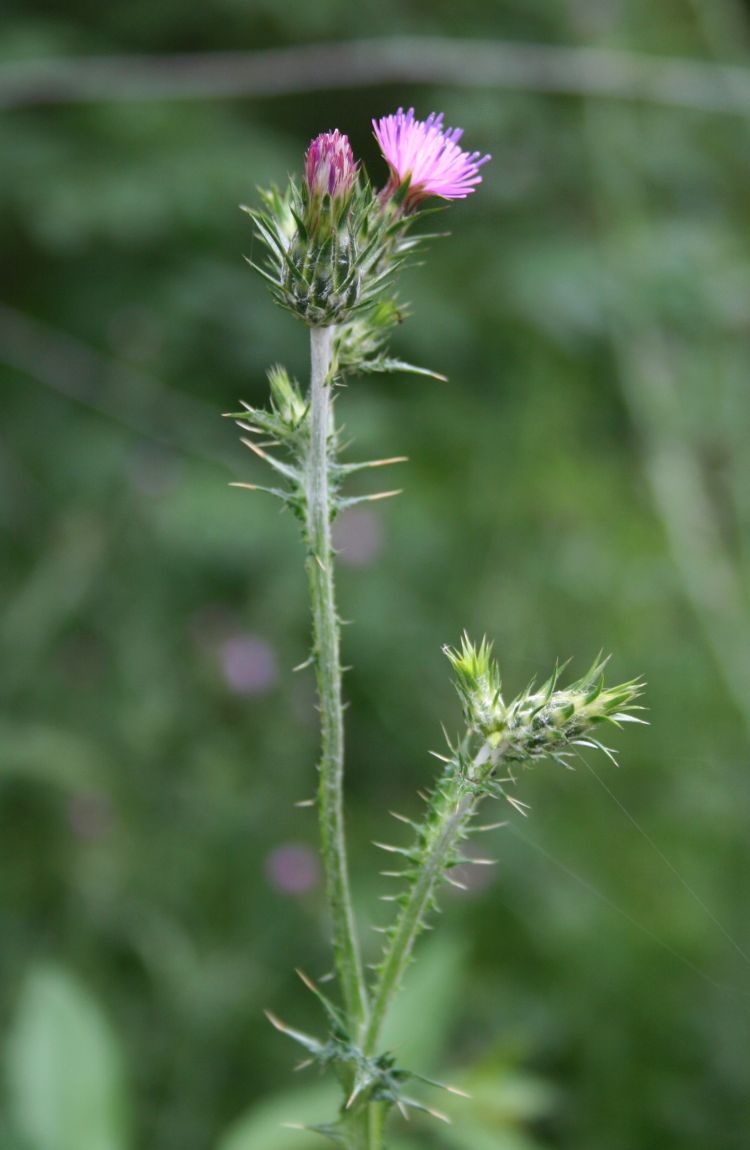
Thistles (genera Cirsium, Carduus, and Onopordum) produce large, accessible flower heads that offer substantial volumes of nectar and pollen over extended daily periods. Unlike many entomophilous plants that restrict access to specialist visitors through deep tubular florets, the disc florets of most Italian thistle species are accessible to a broad range of insects with mouthparts from 3 mm to 15 mm in length. This structural openness makes thistles ecologically significant as generalist foraging resources in landscapes where specialist floral resources have declined.
In northern Italian semi-natural grasslands surveyed between 2018 and 2022, Cirsium and Carduus flower heads collectively accounted for 12–18% of all timed pollinator observations during July and August — a disproportionately high figure relative to their cover, which rarely exceeded 4% of total vegetation.
Apidae: Bumblebees and Solitary Bees
Bumblebees (Bombus spp.)
Bumblebees are among the most consistent thistle visitors across Italy. Five species are regularly recorded foraging on Cirsium and Carduus flower heads in published Italian studies:
- Bombus terrestris (buff-tailed bumblebee) — the most frequently recorded visitor on lowland C. vulgare and Carduus nutans. Workers forage predominantly for nectar, with pollen collection incidental.
- Bombus pascuorum (common carder bee) — strongly associated with C. arvense in arable margins and overgrown field edges.
- Bombus lapidarius (red-tailed bumblebee) — documented on C. eriophorum in Pre-Alpine grasslands of Lombardy and Veneto; workers and males both visit.
- Bombus sylvarum (shrill carder bee) — recorded on C. italicum in Apennine meadow transects; this species is declining across central Europe and Italian records on C. italicum may represent a critical late-season foraging association.
- Bombus humilis (brown-banded carder bee) — uncommon but recurring on Onopordum acanthium in Po Valley agricultural margins.
Solitary Bees
Several solitary bee taxa show marked preferences for thistle pollen. Females of Andrena fulva and Andrena ovatula have been recorded loading pollen from C. vulgare during late June and July in Emilia-Romagna. Halictus scabiosae, a polyester bee that lines its brood cells with secretions from the abdominal Dufour's gland, is a regular visitor to Carduus acanthoides and C. nutans along road verges in the northern plain.
Syrphidae: Hoverflies
Hoverflies (family Syrphidae) are consistent short-tongue visitors to thistle flowers, foraging primarily for pollen. The following taxa are regularly observed on Italian thistle species:
- Episyrphus balteatus — recorded on all six principal grassland species; one of the highest-abundance hoverfly visitors in lowland transects.
- Eristalis tenax and E. arbustorum — frequent on C. vulgare and Carduus nutans; larvae develop in decaying organic matter in wet soils, making proximity to ditches and water channels a habitat requirement.
- Volucella bombylans — occasional, usually on C. eriophorum in montane sites above 1,000 m.
- Sphaerophoria scripta — common on C. arvense and Carduus acanthoides in arable margins across the Po Valley.
Hoverfly diversity on thistles in Italian surveys peaks in late July, correlating with the simultaneous peak flowering of C. vulgare, Carduus nutans, and Onopordum acanthium in lowland sites. At higher altitudes (1,200–1,800 m) the hoverfly peak is delayed to August, tracking the later bloom of C. eriophorum.
Lepidoptera
Several butterfly species with Italian populations rely substantially on thistle nectar as a mid-summer foraging resource. The most thoroughly documented associations involve:
- Vanessa cardui (painted lady) — a migratory species that uses Carduus and Cirsium both as larval host plants and as adult nectar sources. Mass emergence years (e.g. 2019, 2022) coincide with high use of Italian Carduus-rich grassland margins.
- Argynnis paphia (silver-washed fritillary) — adults feed heavily on C. eriophorum and C. vulgare in Pre-Alpine woodland edges from late June to early August.
- Melitaea cinxia (Glanville fritillary) — primarily associated with Plantago as a larval host but uses thistle species as adult nectar sources in the Apennine grasslands where its Italian populations are concentrated.
- Papilio machaon (swallowtail) — occasional visitor to large-headed Onopordum and Cirsium in central Italy; more commonly seen on Apiaceae but thistles provide supplementary nectar.

Seasonal Foraging Windows by Habitat Type
The staggered phenology of Italian thistle species provides a near-continuous foraging window from late May to late September in diverse landscapes:
- Late May – June: Carduus pycnocephalus and Carduus acanthoides flower first in coastal and lowland sites.
- June – July: C. italicum, C. palustre, and C. vulgare at lower altitudes.
- July – August: Peak season; C. vulgare, Carduus nutans, and Onopordum acanthium flower simultaneously across most of the country.
- August – September: C. eriophorum and C. spinosissimum at montane levels extend the season into late summer at altitude.
In landscapes where this staggered sequence is intact — for example, in the agri-environment mosaic of the Veneto foothills or the Cilento National Park — total pollinator visitation to thistles is substantially higher than in homogenised cereal landscapes where thistles are suppressed by herbicide.
Conservation Implications
The decline of semi-natural grassland in Italy, documented in successive National Habitat Monitoring reports since 2007, directly reduces the availability of thistle nectar resources. Management practices most strongly associated with thistle retention include late cutting (after 1 August), the maintenance of uncut field margins at least 2 m wide, and reduced herbicide application on arable margins. Where these conditions persist, thistle-associated pollinator communities in Italian grasslands remain substantially intact relative to those in intensively managed arable regions.